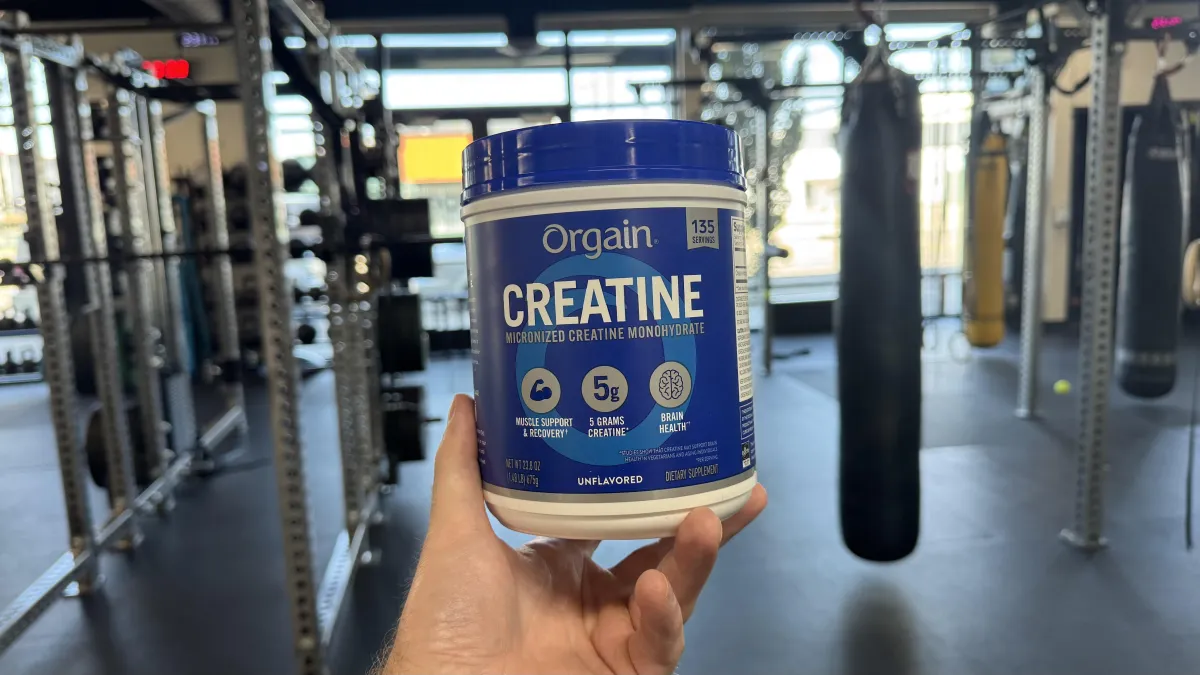
Creatine for Strength and Longevity: Coach Jerryl's Deep Dive For Beginners and Older Adults

The most studied supplement in fitness and why it might belong in your routine.
If you are over 50 or just beginning your fitness journey, you have probably heard someone mention creatine and its long list of benefits. This article cuts through the marketing noise.
I will walk you through what creatine actually is, how your body's energy system works, and why it may be one of the most useful tools for building strength and holding onto your independence as you age.
What Is Creatine?
Creatine is not a drug, a steroid, or a stimulant.
It is a compound your body already makes, and you already eat small amounts of it through red meat and fish.
About 95% of it is stored in your muscles as phosphocreatine, where it does one job extremely well: it rebuilds ATP, the fuel your cells burn for quick, hard effort. ATP (Adenosine Triphosphate) is the primary energy-carrying molecule used by all cells to power biological processes. It captures chemical energy from the breakdown of food molecules and releases it to fuel functions like muscle contraction, nerve signaling, and chemical synthesis.
Think of ATP as the cash in your pocket for immediate work such as standing up out of a chair, catching yourself when you trip, lifting a heavy box. Creatine is the ATM that refills that cash faster.
Supplementing it raises the creatine stored in your muscle by roughly 10 to 40%, giving you a bigger tank to draw from.
The Energy System It Feeds and Why It Matters for You
Your body runs on three energy systems. The aerobic system handles long, steady work like walking. The glycolytic system covers efforts lasting up to a couple of minutes.
Lastly, the phosphagen system powers immediate, all-out effort in the first several seconds. That third system is creatine's home turf.
Here is what is happening under the hood - bear with me.
Your cells run on ATP, but you only store a few seconds' worth at a time. The instant a muscle fires, ATP burns down to ADP, which is spent fuel. Creatine is how you recharge it fast. Stored in your muscle as phosphocreatine, an enzyme called creatine kinase strips a phosphate off it and snaps it back onto ADP, rebuilding usable ATP almost instantly.
Think about it as a charged battery. Supplementing keeps more of that battery on standby, so you can push a little longer and recover between efforts a little faster.
That short, powerful burst is exactly what real life demands when it counts: the sudden effort to regain your balance, the push to get off the floor, the strength to carry groceries up the stairs, plus every heavy load you lift inside the gym.
It is the same system we train in Torq Personal Training's functional strength program.
More creatine in the tank means more capacity in that system, and faster recovery between hard efforts.
What You Will Actually Notice, In and Out of the Gym
Inside the gym, the research is consistent: creatine improves strength, power, and your ability to repeat hard efforts, typically in the range of 5 to 15% for the tasks it helps most (Lanhers et al., 2015; Kreider et al., 2017).
Outside the gym is where it matters most. More strength and lean muscle is not about looking a certain way. It is about functional capability.
It is the difference between needing help off the couch and standing up without a second thought.
For older adults 50 years and older, a meta-analysis found that creatine combined with resistance training produced greater gains in muscle and strength than training alone (Chilibeck et al., 2017).
That combination of lifting and creatine is a direct investment in your longevity and independence. The recommended dose is about 5 grams per day.
Stronger Bones, Not Just Stronger Muscles
Muscle gets all the attention,
but for adults over 50, bone matters just as much.
A fall is only dangerous if there is something to break. Resistance training already loads and strengthens bone, and there is emerging evidence that creatine may enhance that effect.
Particularly at the hip, which is one of the most consequential places to protect as we age (Chilibeck et al., 2017).
The research here is still developing and creatine is not a treatment for osteoporosis. Still, the direction is encouraging, and it lines up perfectly with the goal that drives everything we do - staying capable and staying on your own two feet.
Brain Health
Here is where it gets genuinely interesting, and where I will let myself nerd out a little.
Your brain uses creatine for energy the same way your muscles do. Newer research suggests it may support cognition, especially when the brain is under stress or fatigue from aging or poor sleep.
A systematic review of controlled trials found memory benefits that were most pronounced in older adults (Avgerinos et al., 2018).
Earlier work found improvements in working memory and processing speed (Rae et al., 2003), and a 2024 study found that a single very high dose, One far larger than the daily 5 grams I recommend, improved cognition during sleep deprivation, along with measurable shifts in the brain's energy chemistry (Gordji-Nejad et al., 2024).
For a fuller picture, the reviews by Dolan and colleagues (2019) and Roschel and colleagues (2021) are worth a read.
I am not going to overpromise because this is an emerging area and not a settled fact. However, for a wiser individual, a new beginner, or a busy family man like me, it is a compelling bonus for a supplement you might already be considering.
“Can't I Just Eat More Steak?”
You can get creatine from food such as salmon, tuna, herring, lean red meat, and pork.
All are solid sources but requires a large consumption.
There is only about 1 gram of creatine per pound of raw red meat, and cooking can destroy some of it; making typical diet provide maybe 1 to 2 grams a day.
To hit the 5-gram amount used in the research from food alone, you would be eating about two pounds of meat or fish every single day.
That is expensive, often impractical, and hard on your gut. A single teaspoon of powder does the same job.
The Nutrition and Hydration Piece
Creatine can complement anyone's nutrition, but it does not replace protein or real food.
For strength and longevity, adequate protein and consistent training are the main pillars of your journey. Creatine is a well-supported add-on
On hydration, let's kill a myth. Creatine pulls water into the muscle cell.
That is part of how it works, and not a sign of dehydration. The old claim that creatine causes cramps, dehydration, or heat problems is not supported by the evidence; reviews find it neutral to helpful (Kreider et al., 2017). That small 1 to 2 pounds you might see early on is water inside the muscle versus bloat.
You do not need to force down gallons daily. Just hydrate normally, like anyone who trains should.
Common Misconceptions I Hear at the Gym
“It's a steroid.” No. It is a natural compound found in food, not a hormone.
“It'll hurt my kidneys.” In healthy people, extensive research shows no kidney harm.
Creatine can slightly raise a lab value called serum creatinine, which occasionally gets misread as kidney stress. However, it is not (Kreider et al., 2017). If you have existing kidney disease, check with your doctor first, as you should with anything.
“It's just for bodybuilders.” The older-adult and brain research says the opposite. If anything, creatine becomes more relevant as we age.
Honestly, the most common version I hear in Spokane is quieter than any of these. It usually sounds like, “I'm 55 and just starting out … isn't that stuff for young guys in the weight room?” My answer is always the same: the science points the other direction.
The people who stand to gain the most from creatine are the ones who assume it isn't for them. Once a hesitant client sees that it is food-derived, cheap, and one of the safest supplements ever studied, the wall usually comes down fast.
Who Should Be Cautious
Creatine is remarkably safe for healthy adults, but it is not a free-for-all.
If you have kidney disease or reduced kidney function, talk to your doctor before starting. The same goes if you are managing a chronic health condition, taking prescription medications, or you are pregnant or nursing.
This is not because creatine is dangerous, but because responsible coaching means knowing when a question belongs with your physician instead of your trainer.
When in doubt, ask. A quick conversation with your doctor costs you nothing and buys you peace of mind.
How to Get Started
Keep it simple. Choose creatine monohydrate. It is the most studied, the cheapest, and just as effective as the fancier forms that cost more.
Look for a pure product with 3 to 5 grams per serving; “Creapure” on the label is a common quality marker.
Take 3 to 5 grams a day, every day. A loading phase is not necessary as well. Daily consistency gets you to the same place in about three to four weeks.
Timing also does not matter. I personally add it to my morning smoothie.
How to Know It's Working
Objective: track the weight and reps on a couple of key lifts, plus your own body weight (expect a small early bump from water).
Subjective: notice your energy during sessions, how you recover between them, and your mental clarity.
A simple training log captures both. Not everyone responds identically — heavy meat-eaters may notice less because they are already topped up — but for most people, the change over a few weeks is real and measurable.
Where a Coach Comes In
Here is the honest truth about a blog like this: you could read it, walk into a store, and buy a tub of creatine on your own. It is that simple. But simple is not the same as easy to stick with.
The first few weeks are unremarkable. No fireworks, just steady work and that is exactly where most people quit before creatine has a chance to do its job.
That is the part a coach is built for. At Torq, I help clients pick a quality product instead of an overpriced one, stay consistent through those quiet early weeks, pair the supplement with the strength training that actually makes it work, and recognize when a question should go to their doctor.
The supplement is a small piece. The training, the consistency, and the guidance are what turn it into results.
That is the difference between Googling “should I take creatine” at midnight and having someone in your corner who has used it for two decades and coached hundreds of people through the same starting line.
A Client I Think About - Nancy
I think about a client I used to train when she was in her early seventies. She was not chasing a beach body and wanted to stop dreading the stairs to her apartment and to get up off the floor without planning the maneuver first.
We started her on basic strength work and, a few weeks in, added a daily 5 grams of creatine.
The creatine paired with consistent training improved her progress. Within a few months she was carrying her own groceries up those stairs and getting down to play with her grandkids without thinking twice about getting back up.
It created independence and empowered Nancy to pursue even bigger goals.
My Own Experience With Creatine
I have been taking creatine since 2008, right after I finished high school and started training seriously.
My goals then were simple: get stronger and take any honest edge I could find. Creatine was one of the first things I added, and I have kept it in rotation ever since.Over the years, the payoff has been steady rather than flashy. My strength climbed over time, and I recovered faster after hard sessions.
My favorite part is more subtle — the feeling of being primed and ready to go again. It is a small thing that adds up over a training block.
I have also noticed what it feels like without it. When I go off creatine for a stretch, there is a mild drop-off: recovery is not quite as sharp, and that “ready for the next set” feeling fades a little. It is not dramatic, but it is noticeable enough to mention.
That is almost twenty years of firsthand experience with one of the most studied supplements there is. So when I tell a client to consider it, I am not repeating something I read. I am passing along something that has been part of my own training longer than some of them have been lifting.
My encouragement is simple: give creatine an honest try, stay consistent for a few weeks, and see how you respond. You might notice exactly what I did.
The Bottom Line
I am not a supplement guy. I think most of what is sold on gym shelves is a waste of money, dressed up in a flashy label.
Creatine is one of the rare exceptions. One of the very few supplements that is actually worth the money. It is cheap, it is safe, it is backed by decades of research, and it does exactly what it claims to do when you pair it with real training.
If you are going to spend a dollar on anything in the supplement aisle, spend it here.
Start Where You Are
You do not have to “get in shape first” before any of this matters, and you do not have to figure it out alone.
Supplements are one small piece of the fitness journey, and I think creatine can help.
At Torq Personal Training, our small group personal training in Spokane is built for beginners and older adults 50 years and older who want to build strength, protect their independence, and age on their own terms.
If you are 50 or older and you have been waiting for the right time to start, this is it.
Come in for a beginner-friendly consultation or a free intro session at Torq Personal Training in Spokane, Washington. No ego. No pressure. Just a coach helping you build strength that lasts.
Products We recommend
Brand: Optimum Nutrition Micronized Creatine Monohydrate
https://www.amazon.com/dp/B002DYIZEE?lv=shuf&channelId=500&plpRedirect=mhFallback&th=1
Can also be purchased from your local retailer or CostCo
Brand: Bulk Supplements Creatine Monohydrate
References
Avgerinos, K. I., et al. (2018). Effects of creatine supplementation on cognitive function of healthy individuals: A systematic review of randomized controlled trials. Experimental Gerontology, 108, 166–173.
Chilibeck, P. D., et al. (2017). Effect of creatine supplementation during resistance training on lean tissue mass and muscular strength in older adults: A meta-analysis. Open Access Journal of Sports Medicine, 8, 213–226.
Dolan, E., Gualano, B., & Rawson, E. S. (2019). Beyond muscle: The effects of creatine supplementation on brain creatine, cognitive processing, and traumatic brain injury. European Journal of Sport Science, 19(1), 1–14.
Gordji-Nejad, A., et al. (2024). Single dose creatine improves cognitive performance and induces changes in cerebral high energy phosphates during sleep deprivation. Scientific Reports, 14.
Kreider, R. B., et al. (2017). International Society of Sports Nutrition position stand: Safety and efficacy of creatine supplementation. Journal of the International Society of Sports Nutrition, 14(18).
Lanhers, C., et al. (2015). Creatine supplementation and upper limb strength performance: A systematic review and meta-analysis. Sports Medicine, 45(9), 1285–1294.
Rae, C., et al. (2003). Oral creatine monohydrate supplementation improves brain performance: A double-blind, placebo-controlled, cross-over trial. Proceedings of the Royal Society B, 270(1529), 2147–2150.
Roschel, H., et al. (2021). Creatine supplementation and brain health. Nutrients, 13(2), 586.
Visit us at TorqPersonalTraining.com
